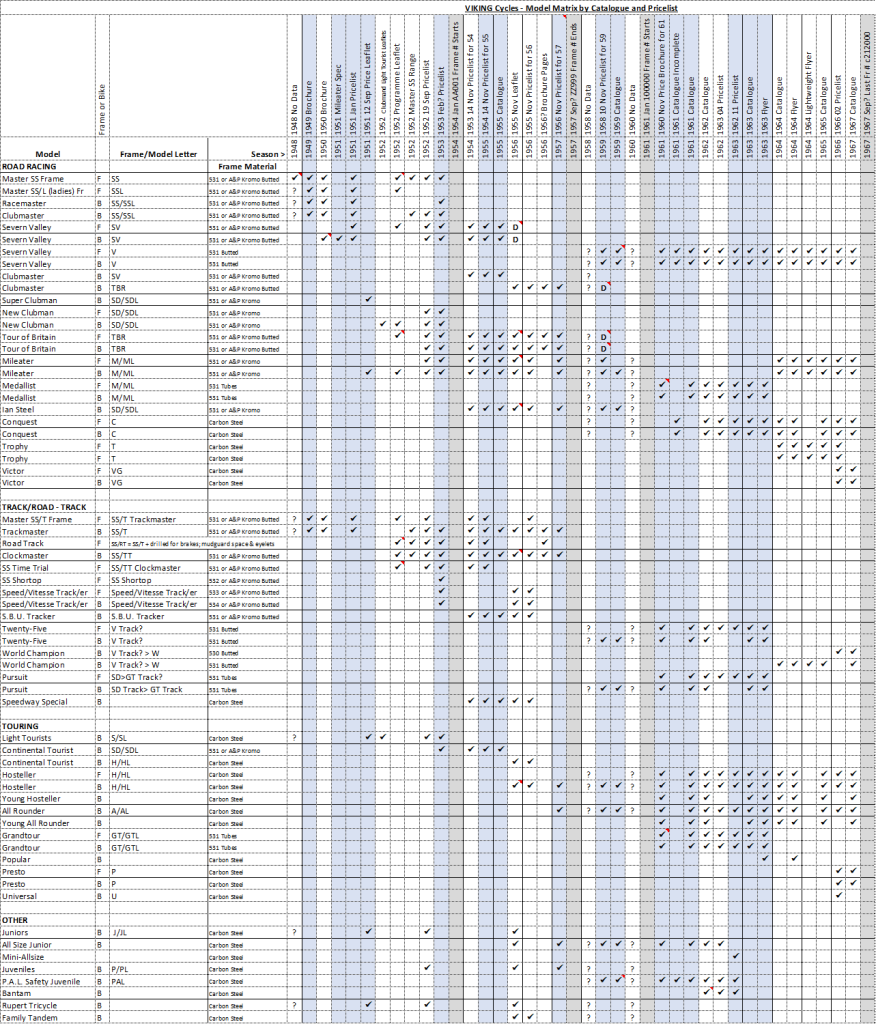
This chart shows the models available by year as identified from brochures, catalogues, flyers and pricelists from 1949 to 1967 when Viking Cycles Ltd ceased trading.

Not much information seems to exist on Viking models before 1940. The earliest catalogue information that I have relates to 1949. Trawling through the internet has not thrown light on anything other than the “Master Series SS” frames, designed for club riding and racing, with SS/T (track) and SS/L (ladies’) versions. The SS was built up as a Clubmaster or as a Racemaster, the names being self-explanatory, and the SS/T was built up as a Trackmaster. We don’t have much information on the relative volumes of frame sales versus bike sales but we would imagine that more were sold as frames because of the punitive Purchase Tax that applied to complete bikes but not to components.
The photographs of circa 1950 cycle show stands show a range of bicycles, including children’s and more utilitarian models, which I suspect were not built by Viking (the Co-op has been suggested as a source). Many cycle dealers would handle just one or two brands, so these bicycles enabled Viking dealers to offer a full range to meet all needs and earn some extra cash.
In 1950, the Severn Valley was introduced and marketed as more suitable for road racing. It had slightly more upright angles than the SS, which continued alongside. The price lists show the Severn Valley as costing more than the SS, even though it did not have any chrome as standard, whereas the SS had a 3/4 chrome front fork as standard. Additional chrome was available as an option on all models.
Viking sponsored a racing team in all this time, presumably riding Master SS until the Severn Valley came along, and this was presumably the frame on which Ian Steel won the 1951 Tour of Britain, unless, of course, the team rode special bikes, on which the Tour of Britain model, introduced in 1952, was based.
The Tour of Britain model was the range’s flagship for several years with its Nervex Professional lugs and reinforced pump pegs and rear brake bridge – arguably unnecessary features but sounding good for the catalogue description.
All the above models were constructed with Reynolds 531 butted tube sets, with Accles and Pollock Kromo stated as an alternative. However, the Mileater, introduced in 1951, used straight gauge rather than butted tubes. as did the Ian Steel model, introduced maybe a year or two later. The Ian Steel model was an entry-level racer at a lower price point than the other models, clearly designed to capitalize on his racing success. This model had the front gear shift arrangement favoured by Ian Steel, whereby the cable from a handlebar control went via a stop on the top tube to a Sturmey-Archer-type cable pulley just under the seat lug and then down to the Benelux front derailleur. This same arrangement has been seen on Tour of Britain frames but is not mentioned in the catalogues as a feature of the ToB.
The Severn Valley appears to have dropped out of the catalogue for 1956 and then reappeared in 1957, replacing the Tour of Britain as the top model while acquiring Nervex Professional lugs. The catalogues do not show the Tour of Britain continuing beyond 1956, but some owners say they have later Tour of Britain models. I hope to get to see some of these and check their features. Not being listed in the catalogue does not mean they did not exist – anything is possible with Viking. From this distance, we do not know whether it was a strength or a weakness that Viking was prepared to make variations in specification to suit individual customers. It increases production costs and would only have been good business if it gained customers or enabled them to charge profitably for these variations.
This more detailed chart shows the models available as identified from specific brochures, catalogues, flyers and pricelists that we currently have available from 1949 to 1967.